Technical rider of the project
1. Conceptual and Theoretical Framework
The World Is a Vibration is a multi-screen audiovisual installation investigating image as an energetic and temporal phenomenon rather than a narrative construct.
The work departs from the collapse of explanatory language. Instead of storytelling, it operates through oscillation, duration, and resonance between parallel image fields. The installation creates a spatial condition in which meaning emerges through rhythm, repetition, and perceptual tension across multiple screens.
The project examines:
the exhaustion of narrative structures,
the image as vibration rather than representation,
time as a material,
landscape as a residual field after ideological or symbolic collapse.
The work positions itself within the expanded cinema tradition, where cinematic language extends into architecture and spatial experience. Technology functions structurally — shaping temporal behavior, synchronization, and spatial relationships — not as spectacle.
The viewer is immersed in a suspended perceptual environment where resonance between screens becomes the primary generator of meaning.
2. Credits
Artist / Director: Jola Kudela
Concept Development: Jola Kudela
Sound Design / Composition: Julia Kent
Production: One Eyed Pixel Ltd
3. Format
Multi-screen audiovisual installation
Expanded cinema / digital installation
Number of screens: 3 (minimum) – scalable to 5 or 7 depending on space
Resolution: 1920x1080 (Full HD)
Frame rate: 25fps
Audio: stereo or multichannel (adaptable to venue)
Loop duration: 12–20 minutes (seamless loop)
4. Spatial / Architectural Requirements
Minimum space requirement:
Black box or darkened exhibition space
Minimum wall width: 6 meters
Ceiling height: minimum 2.8 meters
Controlled lighting (no daylight interference)
Screen configuration options:
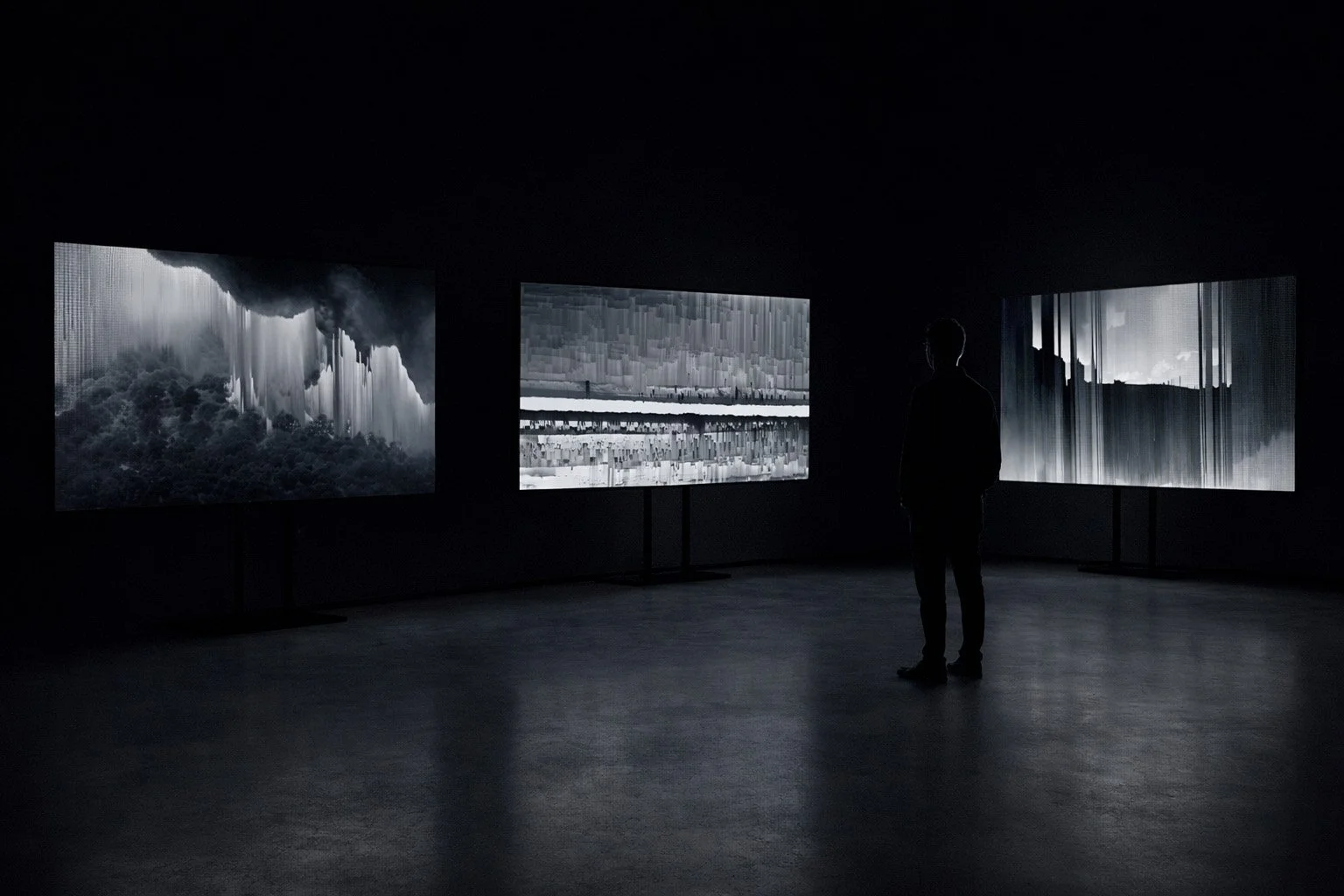
Option A – Linear horizontal alignment
Three screens side-by-side, spaced 30–60 cm apart.
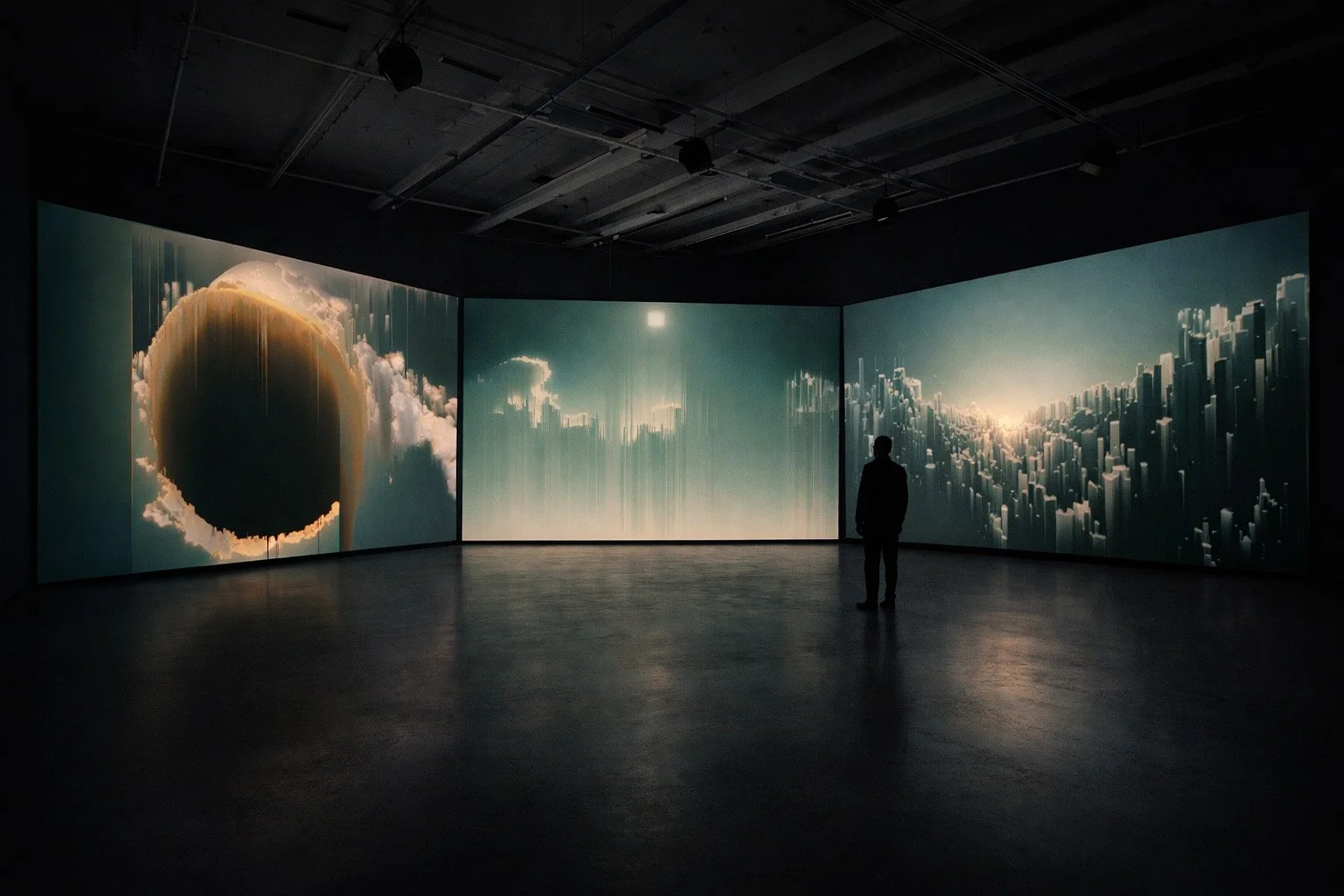
Option B – Spatial resonance configuration
Screens positioned in shallow arc or opposing walls to create perceptual tension.
Viewing distance:
Minimum 3 meters from central axis.
Walls must allow projection or screen mounting.
5. Projection / Display Requirements
Option 1 – Projection:
3 x Full HD projectors (minimum 5,000 lumens)
HDMI input
Ceiling or truss mounting capability
Option 2 – LED / LCD Screens:
3 x 55”–75” Full HD displays
HDMI input
Stable mounting or floor stands
6. Audio Requirements
Stereo minimum (2 speakers).
Preferred: quadrophonic or spatial audio (4 speakers) to enhance spatial resonance.
Audio output:
3.5mm / XLR / HDMI audio split depending on playback system.
Sound pressure level: moderate, immersive but not overpowering.
7. Playback System
Single workstation with multi-output GPU
TouchDesigner runtime environment
File format:
H.264 / ProRes / MP4 depending on playback system.
8. Software Used
Image processing and composition:
LRTimelapse
Autodesk Flame
TouchDesigner (real-time synchronization and spatial modulation)
No internet connection required for playback.
9. Electrical Requirements
220V–240V power supply
Minimum 6 grounded sockets
Dedicated circuit preferred
Estimated power consumption:
3 projectors (approx. 900–1500W total) OR
3 LED screens (approx. 600–900W total)
Playback system (approx. 200W)
Total estimated load: 1.5–2.5 kW depending on configuration.
10. Installation Time
Setup: 1 full working day
Calibration and synchronization: 4–6 hours
Technical supervision by artist preferred during installation.
11. Transportation
Digital delivery via secure link or hard drive.
12. Additional Notes
The installation can be adapted to different spatial conditions.
The number of screens may expand or reduce depending on architectural constraints.
The work is loop-based and designed for continuous exhibition format.